Address:
Jl. Kebo Iwa II Gg. Batu Sunia, Padangsambian Kaja, Kota Denpasar
Working Hours:
Monday–Friday: 8:00 AM – 5:00 PM
Saturday–Sunday: 8:00 AM – 3:00 PM


Does mosquito fogging really work in Bali? Learn what fogging actually kills, why mosquitoes return afterward, and why removing breeding sites is essential for longer-lasting control.
If you live in Bali, you may have heard about mosquito fogging as a quick way to deal with mosquitoes around a villa. It is common to see fogging used in gardens, outdoor areas, and residential neighborhoods, particularly when mosquito activity becomes noticeable.
But does it actually work?
Yes—but fogging is not a complete solution to a mosquito problem.
Understanding what fogging does, and what it does not do, is important if you are considering it for your Bali home.
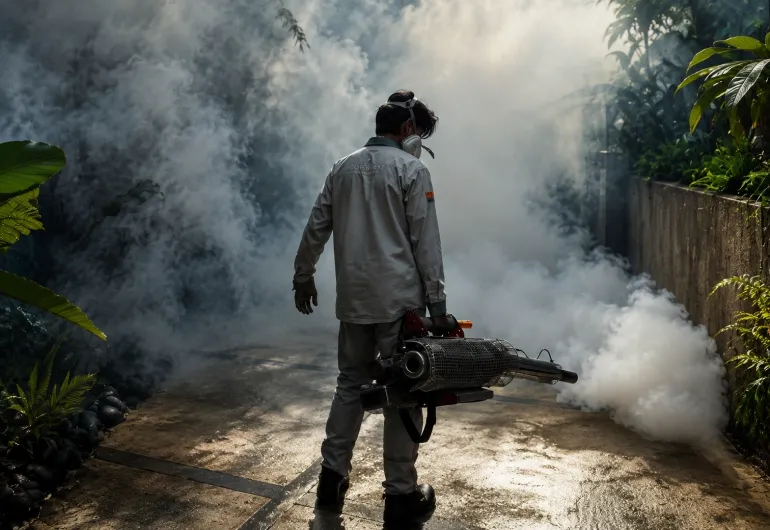
Mosquito fogging releases a fine mist containing an insecticide into an area. The tiny droplets are designed to contact and kill adult mosquitoes that are present when the treatment is carried out.
This can produce a noticeable reduction in mosquito activity soon after treatment.
However, fogging primarily targets mosquitoes that are active at the time of application. It does not remove every mosquito from the property, and it does not permanently prevent new mosquitoes from arriving.
This is why a villa can feel almost mosquito-free after fogging and then start experiencing mosquitoes again later.
The main reason is simple:
Fogging doesn’t remove the conditions that allow mosquitoes to reproduce.
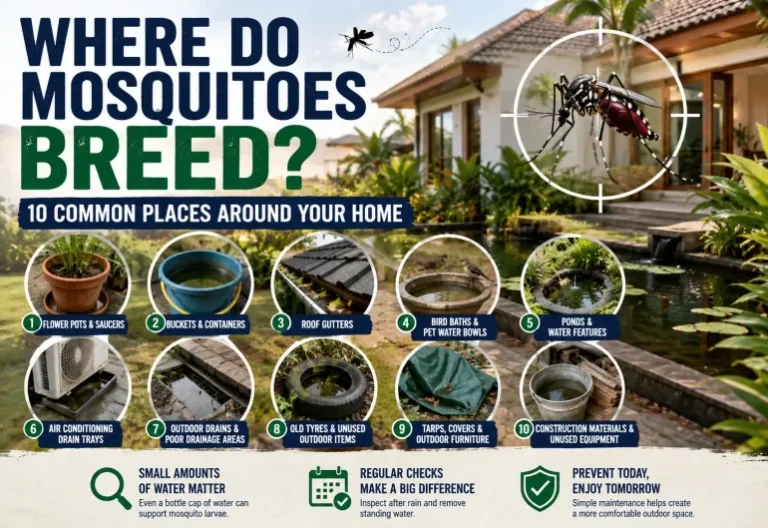
Mosquitoes can lay eggs in surprisingly small amounts of standing water. Around a Bali property, potential breeding sites can include:
After the adult mosquitoes have been reduced, new mosquitoes can emerge from these breeding sites.
Mosquitoes can also enter your property from neighboring gardens, drains, vacant land, or other nearby sources.
So if the underlying conditions remain unchanged, fogging may only provide temporary relief.
Standard adult mosquito fogging is primarily intended to control adult mosquitoes, rather than eliminate every immature mosquito developing in water.
This distinction matters.
A mosquito-control program may need to address both:
Adult mosquitoes → targeted adulticide treatment when appropriate
Breeding sites → source reduction and, where necessary, larval control
The CDC similarly recommends eliminating standing water around homes because reducing breeding sites is an important part of mosquito control.
Not necessarily.
Some properties experience much greater mosquito pressure than others. A villa surrounded by dense vegetation, standing water, rice fields, drainage channels, or other suitable habitats may have a very different situation from a well-screened apartment in a dense urban area.
Regular fogging should therefore not automatically be treated as a routine requirement.
Instead, it makes more sense to ask:
Why are mosquitoes present in the first place?
If the answer is standing water around the property, fogging more frequently may not solve the underlying problem.
Fogging uses insecticides, so it should be treated as a pesticide application rather than simply a harmless cloud of smoke.
Safety depends on the product, concentration, application method, and exposure.
People and pets should follow the precautions provided by the applicator and product instructions. Food, cooking utensils, and other items that could be contaminated should also be protected appropriately.
This is one reason professional mosquito control should focus on targeted application, rather than simply using more insecticide.
It can be—especially when adult mosquito activity is high and a rapid reduction is needed.
But fogging works best as one part of a broader mosquito-management strategy, rather than as the entire strategy.
A more effective approach combines:
Inspect → Remove breeding sites → Reduce entry points → Monitor → Treat when necessary
This is consistent with the principles of Integrated Pest Management, which emphasizes prevention and monitoring before relying on pesticides as the only solution.
Mosquito fogging does work, but its effect is usually temporary.
It can reduce adult mosquitoes that are present during treatment, but it does not automatically eliminate breeding sites or stop mosquitoes from returning from surrounding areas.
For a Bali villa, the better question isn’t simply:
“How often should I fog?”
It is:
“Why are mosquitoes able to keep coming back?”
Once that question is answered, fogging can be used more selectively—and often more effectively.
Looking for a more targeted approach?
Read more about mosquito control in Bali and how different control methods can be used around homes and villas.