Address:
Jl. Kebo Iwa II Gg. Batu Sunia, Padangsambian Kaja, Kota Denpasar
Working Hours:
Monday–Friday: 8:00 AM – 5:00 PM
Saturday–Sunday: 8:00 AM – 3:00 PM


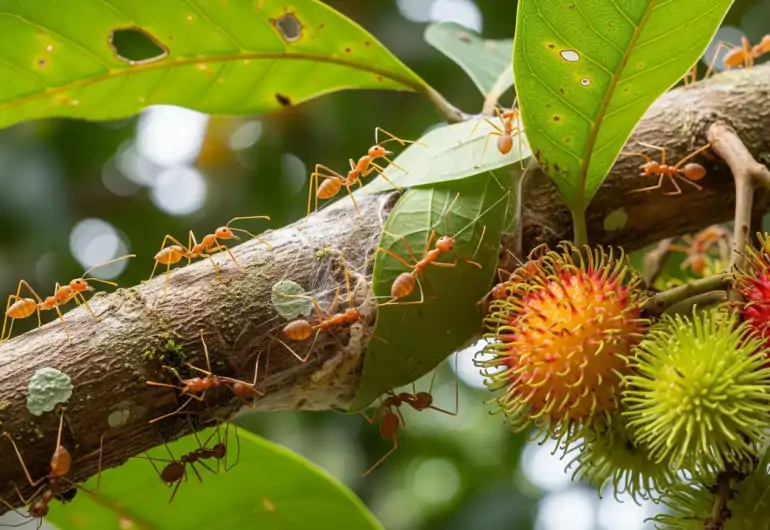
Red weaver ants can make pruning mango trees and enjoying your Bali garden uncomfortable. Learn how to recognise their leaf nests, understand their defensive behaviour, and manage ant activity around villas and fruit trees.
 ByAriastra
If you have ever pruned a mango tree in Bali and suddenly found red ants crawling over your arms, you know how uncomfortable the experience can be. These ants may appear harmless while moving between branches, but they can become aggressive when someone disturbs their nest.
For villa owners and residents, the problem is not limited to the garden. Ants may occupy trees beside outdoor dining areas, walkways, swimming pools, and entrances. Pruning, harvesting fruit, or brushing against an occupied branch can trigger a defensive response.
These ants are often called red ants, tree ants, or weaver ants. One common tropical species is the Asian weaver ant (Oecophylla smaragdina), also known as the green tree ant in some regions. Here is how to recognise them, understand their behaviour, and manage their nests around a Bali property.
Weaver ants are tree-dwelling ants found across tropical parts of Asia and the Indo-Pacific region. They are commonly associated with mango, citrus, and other trees that provide suitable nesting sites.
Their most distinctive feature is their nest. Unlike ants that build underground mounds, weaver ants bring living leaves together and fasten them using silk produced by their larvae. The result is a folded or enclosed cluster of leaves in the tree canopy.
Look for these signs:
Colour alone is not a reliable way to identify the species. Weaver ants may appear reddish, orange-brown, or greenish depending on their location and appearance. Other tropical ants can also be red and aggressive.
If identification matters for treatment, take a photograph from a safe distance rather than handling the ants or opening the nest.
Weaver ants are territorial and defend their nests against perceived threats. Routine gardening can therefore trigger an unexpectedly strong response.
When a gardener cuts a branch, shakes a tree, or touches a nest, worker ants may rush towards the disturbance. They can bite with their jaws and spray formic acid, which may cause irritation or pain.
This behaviour explains why an infestation may seem to appear suddenly. The ants may have occupied the tree for weeks or months without causing an obvious problem. The disturbance, rather than the initial presence of the ants, is what makes them noticeable.
A discussion on the Bali expat forum Balipod describes residents encountering red ants while pruning mango trees. Participants also mention leaf nests on mango and lime trees. These accounts illustrate a practical problem for local gardens, although the exact ant species in the discussion was not scientifically confirmed.
The key lesson is to inspect trees before pruning. Look for leaf nests and ant trails before cutting branches, harvesting fruit, or asking a gardener to work in the canopy.
Weaver ants generally bite rather than sting like bees. Their defensive response can nevertheless be painful, particularly when many ants are disturbed at once.
Not necessarily. Weaver ants have a complicated relationship with garden trees.
They are predators of various insects, including some caterpillars and other agricultural pests. Research on mango orchards in northern Australia has found that abundant weaver ants can help reduce certain insect pests, including thrips.
However, weaver ants also collect honeydew, a sugary substance produced by sap-feeding insects such as aphids, mealybugs, and scale insects. They may protect these insects from predators, allowing some plant pest populations to persist.
This means that the presence of weaver ants does not automatically indicate that a tree is unhealthy. Their impact depends on the surrounding insect community, the tree, and the purpose of the garden.
There can also be practical disadvantages. Large colonies may make pruning, fruit harvesting, and routine garden maintenance difficult. Research in mango orchards has also documented dark marks on fruit associated with formic acid and interactions between ant colonies.
For a residential garden, the sensible approach is to assess the actual problem rather than assuming that every weaver ant nest must be removed.
The appropriate response depends on the nest’s location, the amount of ant activity, and how close the tree is to people and buildings.
Look for folded leaves, concentrated ant trails, and branches with heavy ant activity. Inspect the route from the tree to nearby walls, roof edges, outdoor furniture, and walkways.
Do not shake branches or pull apart a nest to confirm whether it is occupied. Disturbing the nest can provoke a defensive response.
Where practical, trim branches that touch roofs, walls, windows, pergolas, or other structures. This reduces the number of direct routes ants can use to reach a building.
Pruning should be planned around nest locations. If a branch contains an active nest, avoid cutting it casually or asking an unprotected gardener to remove it.
Check whether vegetation creates a bridge between trees and outdoor dining areas, poolside furniture, or entrances. Move food waste and uncovered pet food away from affected areas.
These steps may reduce unwanted encounters without requiring the removal of every ant colony in the garden.
Sticky barriers around tree trunks can sometimes help prevent ants from travelling between the ground and the canopy. However, they must be installed correctly and maintained.
On young or sensitive trees, the adhesive should not be applied directly to the bark if it could cause damage. Use a suitable protective collar or barrier system and follow the product instructions. Branches that bypass the barrier must also be considered.
A barrier will not necessarily eliminate a colony already established in the canopy. It is a way to restrict movement, not a universal solution.
A nest that repeatedly exposes residents or gardeners to bites may require targeted removal or treatment. This is especially relevant when nests are close to frequently used paths, outdoor kitchens, children’s play areas, or entrances.
Avoid climbing into an occupied canopy, cutting nest-bearing branches without preparation, or spraying pesticide indiscriminately across fruit trees and garden vegetation.
Where a nest is high, large, difficult to reach, or close to people, professional assessment is the safer option.
Removing one visible nest may not solve the problem if other nests remain nearby or ants continue to move between neighbouring trees.
Start by mapping the activity. Note which trees contain nests, where ants travel, and whether their trails reach the house. Check for branches touching buildings and for sap-feeding insects on affected plants.
It is also worth considering whether the ants are causing a genuine problem. A nest in a distant part of the garden may be beneficial, while a nest above an outdoor dining table or beside a frequently used walkway may require intervention.
Avoid relying on repeated contact spraying. It may kill exposed workers without resolving the underlying colony. Broad-spectrum pesticides can also affect beneficial insects and other non-target organisms.
A targeted approach should consider the species, nest location, nearby vegetation, human activity, and the potential impact on pets and other wildlife.
Professional help is worth considering when:
A professional inspection can help distinguish weaver ants from other red ant species and determine whether physical removal, access management, or another targeted intervention is appropriate.
At EcoforPest, the aim is to understand the pest problem and its surroundings before selecting a suitable control method. The objective is to reduce unwanted encounters and manage problematic ant activity without treating every ant in the garden as a threat.
Asian weaver ants generally bite rather than sting like bees. They may also spray formic acid, which can cause irritation or pain. Other red ant species may behave differently, so identification is important.
Not necessarily. Weaver ants prey on various insect pests and can be beneficial in some trees. Consider removal or targeted treatment when their activity creates a safety concern or interferes with garden use.
Mango trees provide branches and leaves that can be joined to form protective nests. Weaver ants may also forage in the canopy for insects and sugary food sources.
Pruning branches away from buildings can reduce access to structures, but it does not guarantee that ants will leave the tree or that new nests will not form. Inspect for nests before pruning and address recurring activity where necessary.
No. Several ant species can appear reddish and bite or sting. Leaf nests made by joining leaves with silk are a useful clue for weaver ants, but a photograph or professional identification may be needed for confirmation.
Ant Control · Bali
Aggressive ants can make garden maintenance and outdoor living uncomfortable. Identifying the species and locating their nests is an important first step towards choosing the right control approach for your property.