Address:
Jl. Kebo Iwa II Gg. Batu Sunia, Padangsambian Kaja, Kota Denpasar
Working Hours:
Monday–Friday: 8:00 AM – 5:00 PM
Saturday–Sunday: 8:00 AM – 3:00 PM


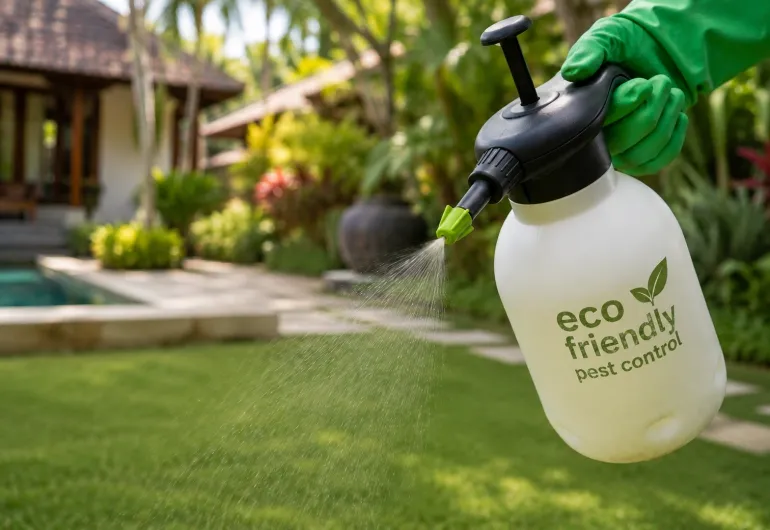
Eco-friendly pest control in Bali does not necessarily mean using only natural pesticides. A responsible approach combines prevention, inspection, monitoring, non-chemical methods and targeted treatments based on the type and severity of the infestation. Natural products can be effective in certain situations, but serious infestations may require synthetic pesticides. Ecoforpest aims to minimise unnecessary chemical use while choosing the most effective and appropriate treatment for each property.
Eco-friendly pest control does not mean using only natural pesticides. In Bali, a responsible pest control approach is about choosing the most effective method with the lowest practical risk, starting with prevention, sanitation, exclusion, monitoring and non-chemical methods whenever they can control the problem. Natural or biological pesticides can be useful, but they are not effective for every pest or every level of infestation. Synthetic pesticides may still be necessary when other methods are not enough.
This distinction is particularly important for expats, villa owners and businesses in Bali who want effective pest control without unnecessary chemical use.
Not necessarily.
There is a genuine pest management approach behind the term: Integrated Pest Management (IPM).
IPM combines different methods based on the pest, the property, and the severity of the infestation. The objective is not simply to kill as many pests as possible, but to keep pest populations under control while reducing unnecessary risks to people, animals and the environment.
This can include:
So, an eco-friendly pest control company does not necessarily need to be chemical-free.
Yes, some natural pest control products are genuinely effective. But their effectiveness has limits.
Biopesticides can be derived from plants, microorganisms, animals and certain minerals. Some are designed to target specific pests and can be useful as part of an IPM programme.
However, this is very different from saying that every natural ingredient found online can eliminate an established infestation.
You may find advice recommending:
Some of these substances may repel or kill certain insects under particular conditions.
The problem is that repelling a few visible insects is not the same as eliminating an infestation.
For example, a substance might affect ants that come into direct contact with it, but have little effect on the colony hidden elsewhere. Similarly, a natural spray might discourage mosquitoes temporarily without removing the standing water where they breed.
Research on homemade botanical insecticides also shows that their effectiveness can vary considerably depending on the plant, concentration, preparation and target pest.
So the claim “natural product X kills pest Y” may be technically true in a particular situation, but it does not mean it will solve every infestation of pest Y.
Natural or lower-risk methods can work very well when the pest problem is small, localised or primarily caused by environmental conditions.
For example, if ants are entering a villa because of accessible food, removing the food source and sealing entry points may be more effective than repeatedly spraying them.
For mosquitoes, eliminating standing water can be more important than treating adult mosquitoes.
For some minor insect problems, traps, sanitation or biological products may provide sufficient control.
This is why prevention is often the most environmentally friendly form of pest control.
The less opportunity pests have to enter, feed and reproduce, the less treatment is needed later.
This is where the “natural is always better” approach becomes unrealistic.
Natural methods may not be sufficient when:
Consider the difference between a few cockroaches in a villa kitchen and an established cockroach infestation inside the kitchen structure.
They may look like the same problem, but they require very different levels of intervention.
The same applies to termites. A natural repellent may affect termites that are directly exposed to it, but that does not necessarily mean the termite colony inside or beneath a building has been eliminated.
In these situations, insisting on natural products regardless of the circumstances may simply delay effective control.
Not automatically.
Synthetic pesticides can have environmental and health risks, particularly when they are misused, over-applied or applied without considering non-target organisms.
But “synthetic” does not automatically mean “environmentally harmful,” just as “natural” does not automatically mean “safe.”
The actual risk depends on factors such as:
This is why IPM focuses on appropriate and targeted pest management, rather than simply dividing products into “natural = good” and “synthetic = bad.”
At Ecoforpest, we do not claim that every pest problem can be solved with natural pesticides.
We also use synthetic pesticides when they are necessary.
Our approach is to first understand the pest problem and its severity.
We consider:
Depending on the situation, treatment may involve sanitation, exclusion, monitoring, traps, biological or lower-risk products, targeted chemical treatment, or a combination of methods.
Synthetic pesticides are therefore not our automatic starting point. They are used when the level or type of infestation requires a more reliable intervention.
This is important because an ineffective treatment is not necessarily a more environmentally responsible treatment.
If a serious infestation continues because the chosen method is too weak, the pest population can continue to grow, causing greater damage and potentially requiring more intensive treatment later.
For expats looking for eco pest Bali services, the better question is not simply:
“Do you use natural pesticides?”
Instead, ask:
“Do you inspect before treating?”
“Do you consider non-chemical methods?”
“Do you avoid unnecessary pesticide application?”
“Is the treatment selected according to the pest and infestation level?”
That is a much more meaningful definition of responsible pest control.
At Ecoforpest, our goal is to reduce unnecessary chemical use without compromising the effectiveness of pest management.
We use different control methods depending on the situation, with natural and lower-risk approaches considered whenever they can provide reliable results. When they cannot, an appropriate synthetic treatment may be necessary.
For us, eco-friendly pest control is not about pretending chemicals do not exist. It is about using pest control more thoughtfully, selectively and responsibly.