Address:
Jl. Kebo Iwa II Gg. Batu Sunia, Padangsambian Kaja, Kota Denpasar
Working Hours:
Monday–Friday: 8:00 AM – 5:00 PM
Saturday–Sunday: 8:00 AM – 3:00 PM


 ByAriastra
When people hear the term pest control, they often imagine strong chemicals, heavy spraying, and a noticeable smell that lingers after treatment.
For many expats living in Bali, this is not an ideal picture—especially in villas where daily life is closely connected to nature, open air, and shared indoor-outdoor spaces.
This is where the idea of eco-friendly pest control becomes important.
But eco-friendly pest control is often misunderstood. It is not about avoiding treatment or using weak solutions. It is about using a smarter, more controlled, and more responsible approach to managing pests—especially in sensitive environments like Bali.
Traditional pest control usually focuses on one goal: eliminate pests as quickly as possible.
Eco-friendly pest control starts differently. It asks a deeper question:
Why are the pests here in the first place?
In Bali, this question is especially important. Villas, homes, and commercial properties are not isolated environments. They are connected to gardens, soil, humidity, and natural ecosystems.
Pests are not random visitors. They are responding to conditions.
Eco-friendly pest control focuses on understanding those conditions first before taking action.
A villa in Ubud once contacted us because of recurring mosquito problems around the pool and outdoor seating area.
The owner had already done several fogging treatments before. Each time, the mosquitoes would decrease for a few days, but then return again.
When we inspected the property, the issue became clearer.
The main problem was not just the mosquitoes themselves, but stagnant water in hidden drainage points and plant containers around the garden. These areas were continuously producing breeding conditions.
Instead of increasing fogging frequency, the solution focused on changing the environment:
improving drainage flow, removing hidden water collection points, and adjusting how outdoor areas were maintained.
After these changes, mosquito activity naturally decreased and did not return at the same level.
In many cases, chemical treatment is the first thing people expect from pest control services.
And while chemicals do play a role, they are not the complete answer.
In Bali, pests often return not because the treatment was weak, but because the environment still supports their survival.
If the root cause is still there—moisture, food access, shelter—then pests will eventually return regardless of how strong the chemical treatment is.
Eco-friendly pest control reduces dependency on repeated chemical use by focusing more on conditions, structure, and prevention.
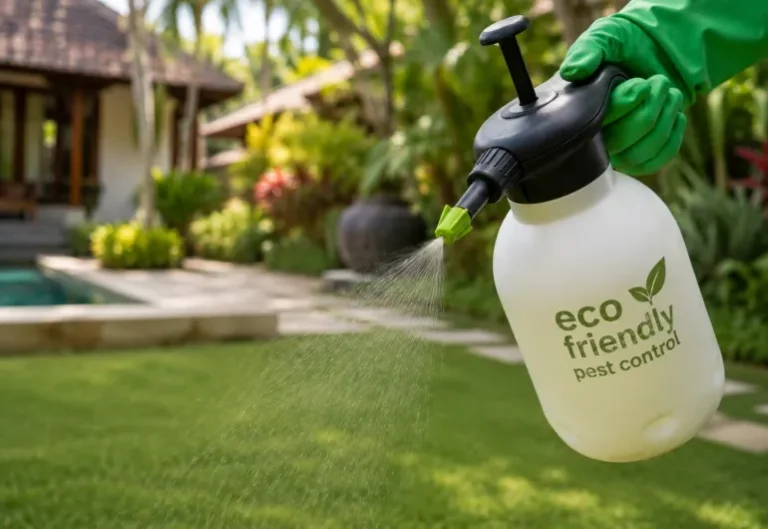
Eco-friendly pest control does not mean “chemical-free.”
Instead, it means:
treatment is targeted, controlled, and necessary—not excessive.
In practice, this usually includes:
careful inspection before treatment, precise application only where needed, and combining treatment with environmental correction.
For example:
instead of spraying an entire villa, treatment may only focus on specific entry points, breeding areas, or structural zones where pest activity is confirmed.
This reduces unnecessary exposure while maintaining effectiveness.
Bali is different from many urban environments.
Here, people live close to nature. Villas often open directly to gardens. Hotels and restaurants operate in semi-outdoor spaces. Even residential homes are often designed to allow airflow rather than full sealing.
This creates a beautiful lifestyle—but also a unique pest dynamic.
Eco-friendly pest control fits this environment because it respects both sides:
the need for comfort and the reality of nature.
It allows properties to stay protected without turning them into heavily chemically controlled spaces.
At Ecoforpest, eco-friendly pest control is not treated as a marketing term. It is part of the working method.
Every treatment starts with inspection. Not because it sounds good, but because without understanding the environment, treatment becomes guesswork.
From there, the focus is always on targeted action. Instead of applying broad solutions, each case is handled based on the actual conditions of the property.
Some properties may require structural adjustments. Others may require minimal treatment combined with monitoring. In many cases, prevention is more important than intervention.
The goal is not just to remove pests, but to reduce the conditions that allow them to return.
For many expats and property owners in Bali, pest control is often seen as a reactive service—something you call when a problem appears.
Eco-friendly pest control introduces a different mindset.
It is not only about solving problems. It is about maintaining balance in the property environment so that problems are less likely to appear in the first place.
This shift is subtle but important.
It changes pest control from a “fixing service” into a form of property care.
Eco-friendly pest control is not about doing less. It is about doing things more precisely, more thoughtfully, and with better understanding of the environment.
In a place like Bali, where nature and living spaces are deeply connected, this approach is not just modern—it is necessary.
The goal is simple:
to protect properties without disrupting the environment they exist in.
If you are looking for pest control that considers both effectiveness and environmental balance, Ecoforpest can help assess your property and recommend an approach that fits your situation.
Start with an inspection to understand what is really happening before deciding on treatment.
This article is based on principles of eco-friendly pest management and sustainable pest control practices from internationally recognized organizations.
These references support eco-friendly pest control principles such as targeted treatment, reduced chemical dependency, environmental safety, and long-term prevention strategies.